wingedhearts.org
Meet Australian wild birds

Site Key Topics Guide

climate change

Australian Academy of Science Reveals Its Ignorance

From The Australian August 18:

THE Australian Academy of Science has pitted its expertise against the greenhouse sceptics in a report stating that humans are changing our climate. ...

Kurt Lambeck, immediate past president of the academy and a professor at the Australian National University's research school of earth sciences, initiated work on the document to clear up common misconceptions. ...

He said the fundamental principles of climatology, such as the role of carbon dioxide in global warming, were beyond dispute. But scientists were still arguing about the complex Earth systems feedback mechanisms, such as the possible cooling effect of clouds.

"If temperatures go up, there is going to be more evaporation, and that will produce more clouds," Professor Lambeck said. "That could produce a negative feedback, but to quantify that is a very difficult thing.

"How do we put that cloud cover into the models? That's where uncertainty comes in, but that's not going to change the basic outcomes."

Really?

A change of just 1% in cloud cover would account for all of twentieth century warming (Plimer's Heaven and Earth p 112). (And that's the claimed warming, including the uncheckable 'adjustments' made by people who have now lost the raw data - but that's another question.)

NOAA Lies About its Own Report

The recent releases from America's NOAA National Climatic Data Center make a convoluted tangle of misinformation that has tripped up almost everyone - including many climate realists.

The confusion starts with NOAA's own website announcing the report at http://www.noaanews.noaa.gov/stories2010/20100728_stateoftheclimate.html. Here's a snapshot of the page (click to see a larger image):

NOAA web page snapshotSee the image of the report cover at the top of the web page? That is not the cover of the Report. Now notice the pretty graphic "Ten indicators of a warming world" a bit lower down. That one is not in the Report, it is in the Report. Confused?

It turns out there are actually two reports, and the NOAA web page only links to one of them. At the bottom of the page, below the bit I screen-captured in the graphic, there is a link to "The Report" - which is the one whose cover is shown on the web NOAA page, and which is also the one written by "more than 300 scientists from 160 research groups in 48 countries". But that Report is not the Report that the NOAA website goes on to describe in detail!

There is a second Report, called "2009 The State of the Climate Highlights", which the NOAA web page does not link to (but which you can see here), which is the source of the alarmist statements quoted on the web page, including this one:

Alternative cause for global warming?

In a comment on a story on Wattsupwiththat,  Julian Flood makes the following interesting suggestion:

No doubt you are familiar with planktonic carbon-fixation paths, but let me remind you anyway. Most plants, phytoplankton included are C3, a process which is discriminatory against the heavier carbon isotopes, so a richly-fed ocean will tend to take up a slightly greater proportion of the light isotope 12C. C3 requires a good level of trace elements, including… zinc and chromium, IIRC, but don’t quote me on that… and without those trace elements the phytos which use C4 will begin to dominate. Indeed, certain flexible phytos will change in those circumstances to C4 from C3. C4 uses much more C13/14 than C3.

A starving, stratified ocean will thus move towards a metabolic pathway which pulls down more heavier isotopes of carbon and the atmosphere will be depleted of those isotopes. I have argued that this is the source of the light isotope atmospheric signal which we are pointing to as the anthropogenic signal.

To Jeremy Grantham: See Why the Global Warming Scare is Threadbare in 5 Minutes

Jeremy Grantham has put out a report claiming to be "everything you need to know about global warming in five minutes". Thank you Jeremy for summarising the global warming case so succinctly. It should make it much easier for readers to see where the truth lies. Here are my comments on your case, please feel free to post any response you wish.

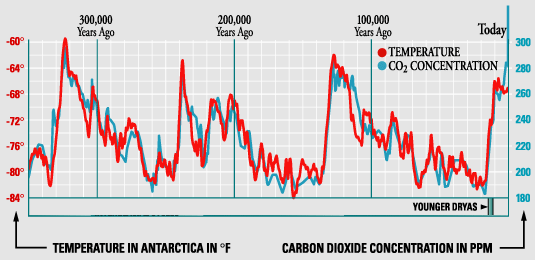
1) The amount of carbon dioxide (CO2) in the atmosphere, after at least several hundred thousand years of remaining within a constant range, started to rise with the advent of the Industrial Revolution. It has increased by almost 40% and is rising each year. This is certain and straightforward.

True. It is also a fact, proved by literally hundreds of careful scientific experiments, and also by every operator of a commercial greenhouse, that almost every plant on Earth grows better—30% better for a 300ppm increase is a conservative average—with more CO2. There are six billion people on Earth, and the increase in CO2 you mention has fed about a billion of them with the same cropland under cultivation. I think you had something else in mind when you mentioned the CO2 increase, but it had better be really important if  you intend us to put it ahead of the lives of billions.

Are we heating the Earth too much - with heat?

As readers will know, I have been thinking about the hullabaloo about CO2 and global warming and I quickly concluded that CO2 is no threat, won't do any significant warming (which would be good anyway), and is in fact 100% good for the planet. But someone said to me, if CO2 is no danger, that doesn't mean that humans are not causing a danger in some other way. Of course I agreed with this, because there are lots of things humans are doing wrongly and thereby causing terrible damage to our world (and the CO2 storm in a teacup is distracting us all from fixing those real problems).

My friend then went on, however, to propose that the danger was still global warming and that the mechanism was, instead of CO2 greenhouse warming, the mere fact that human technology gives off heat. All the power used by all the machines and transport and so on eventually ends up as waste heat. Maybe that is in itself enough to cause us serious warming trouble? So I did some calculations.

According to the laws of thermodynamics, the process of doing useful work must necessarily lose some of the energy from the fuel in the form of waste heat; and that heat, well, heats. In other words, because of the huge extra amount of useful work we do, we create excess heat that would not have been here otherwise, and that heat has to either be dissipated somehow, or else raise the temperature.

The factors that have caused the ice ages, as we saw, are primarily small changes in insolation (heating) by the Sun. The changes can happen because the Sun’s energy output changes or because of cyclic changes in the Earth’s orbit and inclination, etc., changing the amount of heat that actually arrives on the surface. Changes in the Earth’s orbit are believed to be the triggers for the onset of ice ages, and the changes in heating caused by those changes are thought to be quite small compared to the total power output of the Sun. This might lead us to suspect that human-caused changes in the amount of heat at the surface might indeed have a significant effect on the climate.

CBS discredited story still out there

Two years ago, Wattsupwiththat demolished a crackpot story published on CBS (here and here). As stated in the second article, CBS wrongly attributed the story to Associated Press and then killed it without publishing a retraction.

At some time since, that story has been restored on the CBS site, and here is today's screenshot with a bit of surrounding material to prove the date of the screenshot:

CBS story screenshot: Today's Quakes Deadlier Than in Past

Was this data manipulated?

Wattsupwiththat brings us the story of the curving line. Just when the Arctic ice seemed about to break through the long-term average, it made a sudden downturn. Anthony Watts' reader Anthony Scalzi prepared this animation:

The shape of the curve for each day actually changes (goes lower) on the subsequent day. As someone with expertise in computer science, I cannot see any way this can be an outcome of an automated algorithm of any reasonable design. To make the shape clear, I interspersed the four days' images with an image showing all four shapes:

environmental madness kills

Here's a wind farm striking down a bird. The global warming panic has people erecting murder machines without regard for the welfare of animals. And the tragedy is it's all pointless because CO2 is plant food and a boon for the planet, for humanity trying to feed itself, and for wildlife.


Sea level rise? Global warming? I don't think so...

I created this website to explore options for peace, so why do I find myself writing so much about global warming? Well, if there's disharmony in the home and you want the family to talk it through, if you find the house is on fire, you have to do something about the fire first. And the loss of truth in science to push a very bad political 'solution' to a non-problem is a worldwide fire threatening civilisation itself.

Case in point: the lost island in the Bay of Bengal. Here's the BBC, covering itself in inglory pushing political antiscience instead of truth:

Map showing location of "disappeared island" in Bay of BengalA tiny island claimed for years by India and Bangladesh in the Bay of Bengal has disappeared beneath the rising seas, scientists in India say.

The uninhabited territory south of the Hariabhanga river was known as New Moore Island to the Indians and South Talpatti Island to the Bangladeshis.

Recent satellites images show the whole island under water, says the School of Oceanographic Studies in Calcutta.

Its scientists say other nearby islands could also vanish as sea levels rise.

Beneath the waves

The BBC's Chris Morris in Delhi says there has never been a permanent settlement on the now-vanished island, which even in its heyday was never more than two metres (about six feet) above sea level.

In the past, however, the territorial dispute led to visits by Indian naval vessels and the temporary deployment of a contingent from the country's Border Security Force.

"What these two countries could not achieve from years of talking, has been resolved by global warming," said Professor Sugata Hazra of the School of Oceanographic Studies at Jadavpur University in Calcutta.

Anyone wishing to visit now, he observed, would have to think of travelling by submarine.

Very tragic, the loss of that island. Let's see, the sea rose, how much? They were two metres above sea level and now require a visit by submarine? Would that be at the very least, say, three metres, would you think? And in how long a time? India didn't have a navy until after independence in 1947, which is 62 years, or a rise of about five metres per century, which is drivel pure and simple. So much for sea level rise, and so much for the BBC's journalistic skills and/or integrity in reprinting the drivel. But we can actually do much better then this. Here's The Independent's almost as uncritical take on the same story:

It wasn't me!

It particularly irritates me when people make strident claims and then, when the claims are found to be untrue, someone says "Oh well, maybe a few people said that, but not any of us level-headed chaps." In other words, they get the mileage from the absurd claim, but when the claim is caught out, it is downplayed and disowned.

Which brings me to this 2006 article (index.php/ archives/ 2006/ 03/ bush-on-the-debate) from realclimate dot org, the website that proclaims itself "climate science from climate scientists." The site seems to be funded out of the taxes of those of you in America, so it must be reliable (wink wink):

"...warming yes, but is it caused by humans? This position is equally out of step with science, where the debate over this question has also now been settled."

Syndicate content